
Olympia Chimney Chimney Sweep in Sunset Park: A Homeowner’s Guide
If a chimney company can’t name the liner brand they’re installing, that’s not a minor gap. Liner alloy grade and wall thickness decide whether your system lasts 10 years or 30. Olympia Chimney Supply is a professional-grade product line, not a consumer brand, and homeowners searching the term are usually trying to verify whether the company they’ve hired, or are considering, actually installs industry-standard materials. This guide explains what Olympia products are, where they fit in a chimney system, and how material sourcing affects the longevity of any repair in Sunset Park.
If you’d rather not sort through spec sheets and alloy grades on your own, call (866) 937-8201. Estimates are free.
What Is Olympia Chimney Supply, and Why Do Pros Use It?
Olympia Chimney Supply manufactures flexible stainless liners, rigid liner systems, chimney caps, and termination components for the trade. Their products are specified by professional sweeps and installed by contractors, not stacked on a hardware-store shelf for weekend DIYers. That distinction matters more than it sounds.
When a manufacturer sells to the trade, the products are built to survive a life inside a flue: heat cycling, condensate, and the occasional creosote fire. Consumer-facing liners are often built to a price. Professional-tier liners are built to a spec, and that spec is what a sweep can point to when you ask why one quote costs more than another.
We install Olympia systems alongside DuraFlex, HeatShield, Gelco, Famco, and Copperfield because the materials matter as much as the labor. A properly sized liner in the right alloy is the difference between a repair that holds and a callback.
A quick way to think about it: a chimney sweep cleans the flue, but a liner replacement is structural work. The products behind that work should be nameable and verifiable.
Alloy Grades: When 304 Stainless Is Fine and When You Need 316
The single biggest material decision in a liner job is alloy grade. Olympia’s flexible liner systems come in 304 and 316 stainless, and they are not interchangeable. The right choice depends on what you burn and how much condensate the flue sees.
- 304 stainless handles wood-burning appliances in a venting setup where the flue stays dry. It’s your standard choice for a wood stove or fireplace insert that runs hot and doesn’t produce much acidic moisture.
- 316 stainless resists chlorides and acidic condensate better, which is why it’s the grade specified for oil-fired appliances and for gas appliances where the flue runs cooler and wetter.
- Condensing conditions in any flue shorten the life of a lower-grade liner fast. If the flue runs cool or the appliance cycles on and off, the higher grade earns its cost back over the life of the system.
In Sunset Park’s rowhouse housing stock, this decision comes up constantly. Older homes were built for coal or wood and later converted to oil or gas. The flue often wasn’t relined to match the new appliance, and a liner matched to the wrong grade will corrode from the inside within a few seasons. When we specify a liner, we match it to the appliance and the flue, not to what’s on the shelf.
Ask your sweep which grade they’re quoting and why. If they can’t answer in that level of detail, you’ve learned something useful before the job starts.
How Do You Verify a Contractor Is Actually Installing What They Quoted?
You verify by asking for two things: mill certifications and product markings on the liner itself. A mill certification documents the alloy and the source of the stainless coil. Product markings on the liner give you the same information at the installation site. If a company can produce both and explain them, you’re dealing with a professional job.
- Ask for the mill cert before booking. It states the alloy grade. If they can’t produce one, the liner is likely a generic import.
- Look at the liner before it goes in. Olympia liners carry markings identifying grade and manufacturer. Generic liners are often unmarked.
- Compare wall thickness. Professional-grade flexible liners run at a heavier gauge than discount imports. Thinner walls kink during installation and fail sooner.
- Confirm the temperature rating. It should be on the spec sheet. A liner that can’t survive a chimney fire shouldn’t be in your flue.
- Watch the termination. A proper install terminates at the crown with a listed cap, not a length of corrugated tube wedged into the flue.
We name the brands we install, because the materials matter as much as the labor. That’s also why we can hand a homeowner a spec sheet and talk through it line by line. A chimney repair is only as good as the components behind it.
What a Full Olympia Liner Install in a Sunset Park Rowhouse Involves
A proper liner installation in a Sunset Park rowhouse has four stages: sizing, prep, install, and termination. Each one has visible checkpoints, and knowing them is how you tell a real job from a quick one.
Sizing starts with the flue. The liner must be sized to the appliance’s venting needs, not to the flue’s inner dimension. Oversized liners vent poorly. Undersized liners starve the appliance. This is where a proper measurement matters, and it’s the step a low-bid crew often skips.
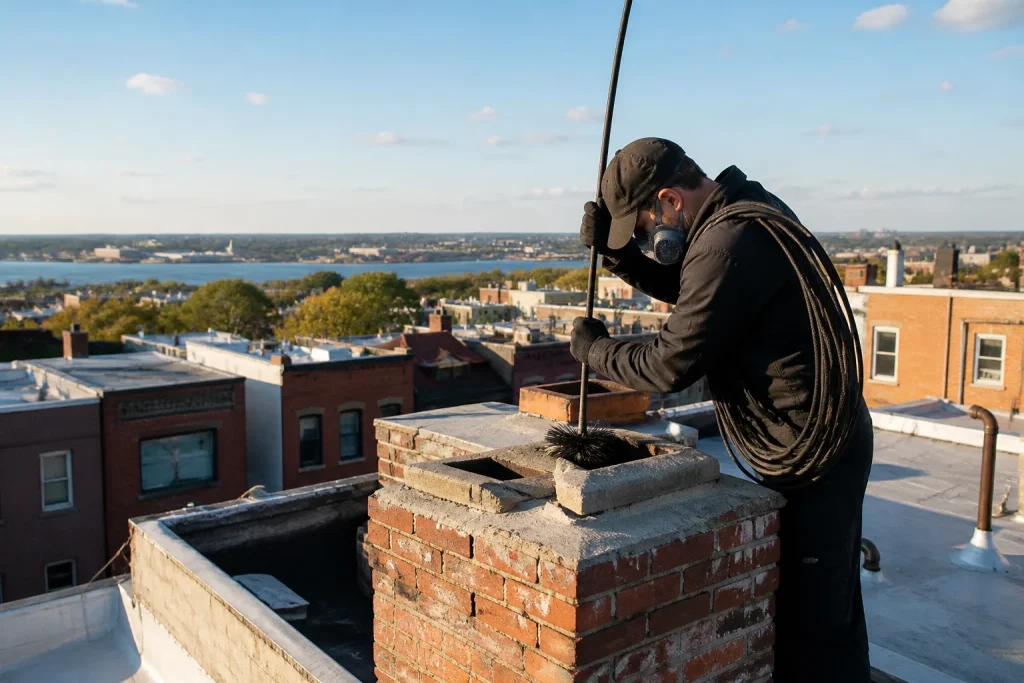
Prep means cleaning the flue thoroughly and checking the interior for cracks, offsets, or obstructions. If the masonry is compromised, that has to be addressed before the liner goes in. This is also where HeatShield comes in: a resurfacing application that restores a deteriorating flue so the liner has a sound substrate. Resurfacing work is beyond what most sweep-only companies can do.
Install is the liner itself, dropped or pulled through the flue, connected at the appliance collar, and secured. The liner should be insulated in most cases, because an uninsulated liner loses heat and condenses more.
Termination happens at the crown. A listed chimney cap & crown protects the liner top from water and debris. A cap isn’t optional; an open flue is a rain funnel and a bird’s nest waiting to happen.
The whole job is one visit when the flue is sound. We diagnose before we quote, so there are no surprise add-ons after the truck arrives. From the firebox to the crown, we handle everything in one visit.
Generic Liners vs. Olympia-Grade Materials: The Measurable Difference
The difference between an Olympia-grade liner and a generic import shows up in three measurable specs: alloy, wall thickness, and temperature rating. You can compare them side by side without taking anyone’s word for it.
- Alloy grade. Generic liners are often a low-grade steel with no certifiable alloy. Olympia’s are 304 or 316, documented and marked.
- Wall thickness. Professional-grade flexible liners run heavier than discount imports. The extra material is what survives installation and heat cycling.
- Temperature rating. Listed liners are tested to a rated temperature. Generic imports often have no listing at all, which means no test standard.
What this means for a Sunset Park homeowner is simple: the cheaper liner usually costs more over time. A generic liner that fails in six or eight years means you pay for the install twice. A properly graded liner in a sound flue is a once-and-done repair.
We spec Olympia, DuraFlex, and Famco on jobs where the flue and appliance call for them. Copperfield and Gelco components fill in the cap and termination side. Every one of those brands is a professional-tier line, not a retail label.
A clean flue is the starting point. A safe, structurally sound chimney is the goal, and material sourcing is a big part of getting there.
When to Call a Pro
Call a pro when the question is about the flue’s interior, not the firebox’s surface. A homeowner can sweep ash and clear a firebox. The moment the work involves the flue liner, the crown, or the masonry around the flue, it’s a job for someone with the right tools and the right materials on hand.
Call us if any of these are true:
- You’ve never had the flue inspected, or you don’t know when it was last cleaned.
- You’re considering a liner replacement and want to verify the materials before booking.
- The chimney has visible cracking at the crown or in the masonry above the roofline.
- You’re buying or selling a home in Sunset Park and need an inspection for the transaction.
Related services in Sunset Park: Chimney Sweep Sunset Park covers annual cleaning and inspection; chimney cap & crown handles the top-end protection; chimney repair covers masonry, liner, and structural fixes; and chimney sweep is where every job should start.
Call (866) 937-8201. We answer 24/7. Fast dispatch from 7am to 7pm, Sunday through Friday.
The Bottom Line
Olympia Chimney Supply is a professional-grade line of flexible liners, rigid systems, caps, and termination components built for the trade and specified by people who work on chimneys for a living. The alloy grade (304 vs. 316) and wall thickness are what determine whether a liner lasts 10 years or 30. If a company can’t name the brand and the grade, ask why, and verify with a mill cert before booking.
For a Sunset Park homeowner with a rowhouse flue that’s older than the appliance it serves, matching the liner to the appliance is the whole job. We work with Olympia, DuraFlex, HeatShield, Gelco, Famco, and Copperfield, and we can walk you through which one fits your setup. Our technicians have up to 11 years of experience, and we diagnose before we quote.
If you’re in Sunset Park and need help, Chimney Sweep Sunset Park offers free estimates. Call (866) 937-8201.
Frequently Asked Questions
No. Olympia Chimney Supply sells to the trade, not to retail. Their flexible liners, rigid systems, caps, and termination components are specified and installed by contractors. That’s why you’ll see the name on a spec sheet rather than a store shelf, and why you can ask a sweep to show you the mill cert and product markings.
304 is typically right for wood-burning appliances in a flue that stays dry. 316 is generally the grade specified for oil-fired appliances and for gas appliances where the flue runs cooler and wetter. The correct choice depends on what you burn and how the flue behaves, which is why we match the liner to the appliance rather than to the shelf. Call (866) 937-8201 for a free estimate.
Ask for two things: the mill certification for the stainless coil and the product markings on the liner itself. Generic imports often carry neither. Wall thickness and temperature rating should also be on the spec sheet. If a company can’t produce those documents, the quote probably doesn’t reflect the materials you were promised.
The liner terminates at the crown with a listed cap that keeps water and debris out of the flue. The connection is checked and secured, and the cap is seated so it protects the liner top. An open flue is a rain funnel and a bird’s nest waiting to happen, so the cap isn’t a cosmetic add-on. If you’d rather not climb up to check, we’ll do it and show you a photo report.
Written by the team at Chimney Sweep Sunset Park.
Need Chimney Cleaning Help?
Call Chimney Sweep Sunset Park - the local pro we connect you with is licensed and insured, here with fast help in Sunset Park.
(866) 937-8201